

Quantum computing is no longer just a futuristic concept — it’s becoming a reality. But with this shift comes a new challenge: quantum programming. Unlike traditional programming, quantum code is built on the bizarre rules of quantum mechanics. So, how is it different, and how do you start?
Let’s explore the key differences, platforms, tools, and a beginner roadmap for stepping into this game-changing field.
🚀 What Is Quantum Programming?
Quantum programming refers to writing software that runs on quantum computers. These systems rely on qubits instead of classical bits, and their behavior is defined by the principles of superposition, entanglement, and interference.
While traditional programs use linear logic, quantum code manipulates quantum states — making it fundamentally probabilistic in nature.
🔍 Classical vs Quantum Programming
🖥️ Classical Programming
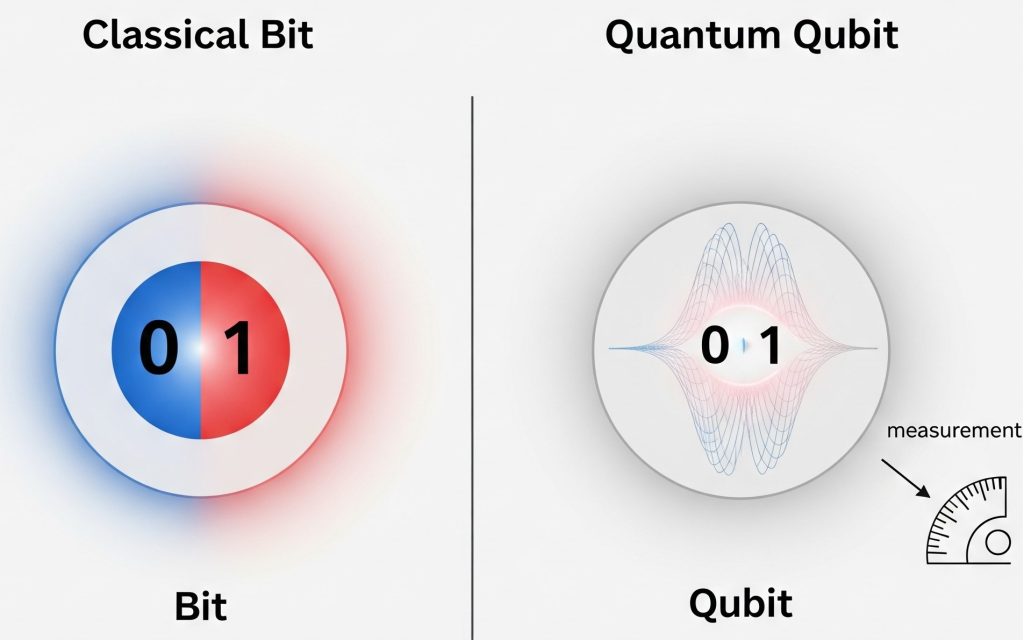
- Uses binary bits: 0 or 1
- Executes code sequentially
- Predictable and deterministic
- Uses common languages like Python, Java, C++
⚛️ Quantum Programming
- Uses qubits, which can be 0, 1, or both at once (superposition)
- Supports parallelism through quantum entanglement
- Probabilistic outputs require statistical validation
- Uses languages like Qiskit, Cirq, Q#
➡️ Transition Example: While classical computing relies on certainty, quantum programming embraces probability and possibility.
💡 Key Concepts You Must Understand
Before diving into code, it’s essential to understand these core quantum principles:
🌀 Superposition
A qubit can exist in multiple states simultaneously — enabling exponential computational power.
🔗 Entanglement
Two qubits become linked so that the state of one instantly affects the state of the other, regardless of distance.
🔄 Quantum Interference
The ability to amplify correct answers and cancel out wrong ones by combining quantum states.
🛠️ Popular Quantum Programming Languages & Tools
1. Qiskit (IBM Quantum)
A Python-based open-source SDK to write and simulate quantum circuits.
🔗 Visit Qiskit.org
2. Cirq (Google)
A framework for creating, simulating, and running quantum circuits on Google’s quantum hardware.
🔗 Explore Cirq
3. Q# (Microsoft)
Microsoft’s quantum programming language integrated with the Quantum Development Kit (QDK).
🔗 Try Q#
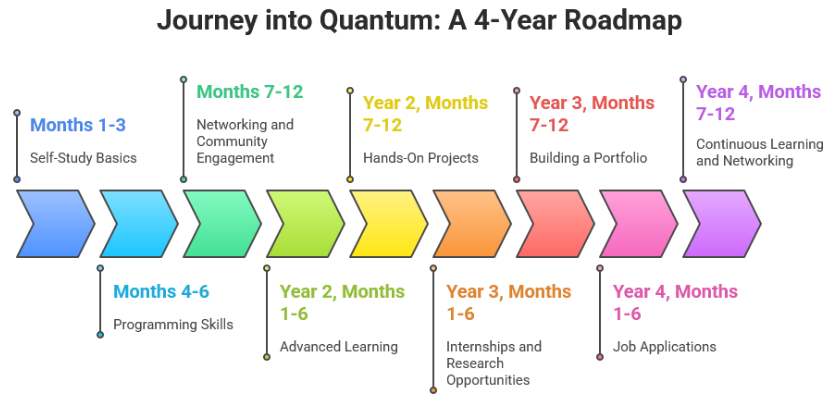
🧭 Where to Begin Your Quantum Programming Journey?
If you’re just starting, follow these steps:
1. Learn Basic Linear Algebra & Quantum Physics
Understand matrices, vectors, and complex numbers — they form the foundation of quantum computing.
2. Start with Simulators
Tools like IBM Quantum Lab let you write and simulate real circuits before using actual hardware.
3. Follow Beginner-Friendly Courses
- IBM’s Qiskit Textbook
- Microsoft Quantum Katas
- edX Quantum Courses
4. Build Simple Circuits
Try building a Bell State or a Quantum Teleportation circuit to get hands-on experience.
🧪 Example: Hello Quantum World (Qiskit)
from qiskit import QuantumCircuit, transpile, Aer, execute

qc = QuantumCircuit(1, 1)
qc.h(0)
qc.measure(0, 0)

backend = Aer.get_backend('qasm_simulator')
result = execute(qc, backend, shots=1024).result()
counts = result.get_counts()

print(counts)
This basic program creates a single qubit in superposition and measures it — giving results of ‘0’ and ‘1’ based on quantum probability.
📈 The Future of Quantum Programming
Quantum software is still in its infancy, but its demand is growing fast. According to McKinsey, industries such as finance, pharmaceuticals, and cybersecurity will heavily rely on quantum algorithms to solve complex problems that today’s computers can’t handle.
Read: The Future of Quantum Computing: A Glimpse into the Next Revolution
✅ Final Thoughts
Quantum programming may seem overwhelming at first, but it offers incredible potential. With the right mindset, foundational physics, and tools like Qiskit, anyone can get started. The future belongs to those who prepare — and in this case, it’s about preparing for a quantum leap in computing.